To all my PCOS, now PMOS, ladies, I want you to take a deep breath, because the medical world is finally catching up to what our bodies have been trying to tell us for years. A global coalition of over 50 medical organizations officially changed “Polycystic Ovary Syndrome” to PMOS: Polyendocrine Metabolic Ovarian Syndrome.
Don’t write this off as a boring semantic update, it’s a massive, validating victory. For decades, women have been told this was a localized reproductive issue about “ovarian cysts.” As a nurse, an exercise physiologist, and someone who has lived through this exact diagnosis, I’m here to tell you that moving this conversation away from just your ovaries and onto your whole-body metabolism changes everything about how we approach healing and restoring balance.
Deconstructing the New Name: What PMOS Actually Means
To understand why your body has felt so out of balance, we have to look at what the letters in this new name actually mean.
- Polyendocrine: This tells us that the issue involves multiple interacting hormone systems, not just your sex hormones (estrogen and progesterone). Your thyroid, adrenal glands, and pancreas are all part of this conversation.
- Metabolic: PMOS directly impacts how your body processes, uses, and stores energy. It dictates why a calorie isn’t just a calorie for you, and why standard weight loss advice fails you.
- Ovarian: Notice how this is now at the very end of the name? That is because your ovaries are a victim of a systemic hormonal environment, not the root cause of the problem.
Let’s bust a massive myth: women with this condition do not actually have structural, painful ovarian cysts. What shows up on an ultrasound are actually just fluid-filled follicles. These are immature eggs that wanted to develop but got stuck because the hormonal signaling in the body was too confusing for them to complete ovulation.
The Real Driver: How Insulin Confuses Your System
The primary signal causing that confusion is insulin. When you have PMOS, your cells become sluggish at responding to insulin, which is a hormone meant to escort sugar out of your blood and into your cells for energy. To compensate, your pancreas pumps out massive amounts of extra insulin to force the doors open. As you can see in the diagram below, this creates a frustrating, exhausting loop.
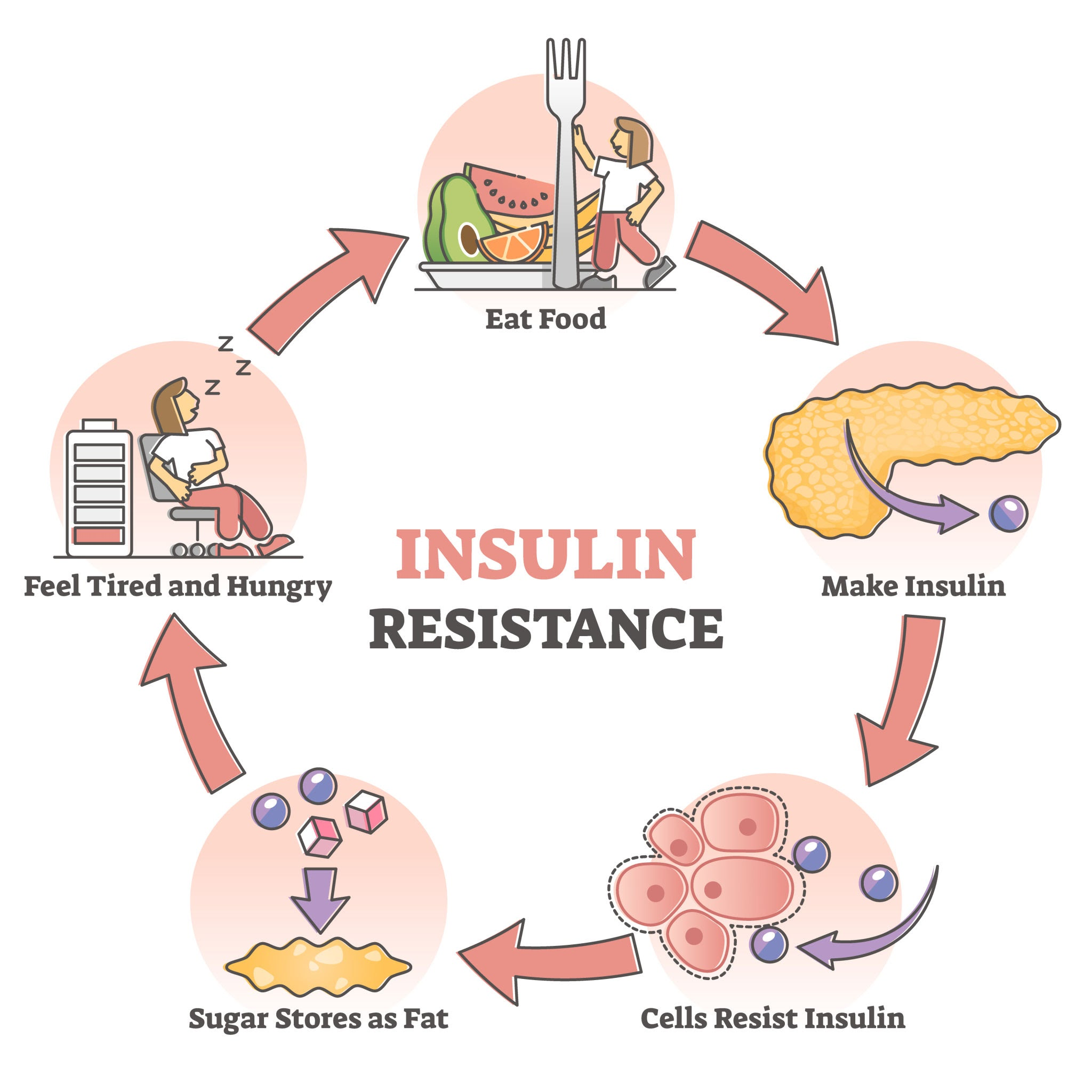
Because your cells are resisting insulin, the food you eat gets prioritized for fat storage instead of being converted into usable energy. This is precisely why you can feel completely exhausted and starved for energy even if you are eating well.
But it gets worse for your hormones. When that tidal wave of excess insulin hits your ovaries, it acts like a loud, disruptive megaphone. It triggers your ovaries to produce an overabundance of androgens (male hormones like testosterone). That specific chemical mismatch is what causes irregular periods, adult acne, hair thinning on your head, and stubborn weight gain around your midsection.
Beyond Fertility: Why This Matters Across Your Whole Life
For years, standard medicine treated this condition as a temporary inconvenience to deal with only when a woman wanted to get pregnant. If you weren’t trying to conceive, you were often handed a birth control pill and told to “come back later” and “try to lose some weight.” That was my exact experience, and as a clinician, it left me deeply disappointed by how we treat women’s health.
Masking a symptom with a pill doesn’t fix a metabolic engine issue. PMOS follows you through every stage of life. If left unmanaged, that chronic insulin resistance increases the risk of Type 2 diabetes and long-term cardiovascular stress. Furthermore, when you layer on typical life stress, chronic stress triggers your liver to dump even more glucose into your bloodstream. This means high stress can worsen your insulin resistance and keep you trapped in that “wired but tired” state, no matter how cleanly you eat.
How to Support a PMOS Body (The Shift to Sustainability)
If your version of trying to fix this has been eating less, cutting out entire food groups, or crushing yourself with high-intensity cardio, I need you to know that you are likely driving your body deeper into survival mode. When your system feels unsafe and under-fueled, its metabolic defense mechanisms kick in, making it hold onto energy even tighter.
Healing a PMOS body requires moving away from extremes and focusing on two science-backed strategies:
- Smart Strength over Chronic Cardio: As an exercise physiologist, I cannot stress this enough. Building skeletal muscle is like building a bigger sink to naturally absorb and use glucose. Strength training allows your body to clear sugar from your blood without needing a massive spike of insulin, lowering the overall hormonal load on your ovaries. But not all strength training is created equal. When we work together, we focus exactly on how to program this effectively for your specific physiology without burning you out.
- Nervous System Regulation: Prioritizing sleep, recovery, and stress management is a clinical necessity. Lowering your stress response stops the constant cortisol spikes that keep your blood sugar elevated.
Reclaim Your Balance
Your diagnosis might have a new name, but the reality of what your body has been experiencing hasn’t changed. What must change is how we approach the solution. You don’t need a perfect diet or extreme restrictions that push your nervous system further into overdrive. You need a sustainable plan that addresses what is happening beneath the surface of your unique physiology.
If you are tired of trying to outrun your hormones and you are ready to finally build a body that feels steady, strong, and metabolically supported, you don’t have to figure it out alone.